

Pediatric dentistry is dental care for children from their first tooth through the teen years, focused on prevention, gentle treatment, and healthy habits at home. Elite Dentistry offers checkups, cleanings, fluoride, sealants, fillings, and emergency care for kids in Addison, with Saturday hours for busy families.
Every parent remembers the first time their child’s tooth broke through the gums. That small moment marks the start of a lifetime of oral health, and the habits a child builds in the early years often stay with them well into adulthood. At Elite Dentistry, we have spent a decade caring for families throughout Addison and the west suburbs, and some of our most rewarding work happens when a nervous toddler leaves our office smiling and asking when they can come back.
Families searching for a kids’ dentist in Addison usually want the same things: a team that is patient with children, a clean and welcoming office, honest explanations, and care that focuses on prevention rather than repairs. That is exactly how we approach pediatric dentistry. Dr. Mohamed Waheed and Dr. Nisreen Al Farra treat patients of all ages, which means your child can grow up with the same dental team that cares for you, your partner, and even grandparents. On this page, we explain what pediatric dental care looks like at our practice, what to expect at each stage of your child’s development, and how we help Addison families keep their children’s teeth healthy from the first tooth through the teenage years.
Why Children’s Teeth Need Specialized Attention
It is easy to assume baby teeth do not matter much because they eventually fall out. In reality, primary teeth do far more than most parents realize. They help children chew properly and get the nutrition they need, they play a major role in speech development, and they hold space in the jaw for the permanent teeth that will come in later. When a baby tooth is lost early to decay, nearby teeth can drift into the gap, which may lead to crowding and bite problems down the road.
Children’s teeth are also more vulnerable than adult teeth. The enamel on primary teeth is thinner, so cavities can spread through a tooth faster. Young children are still developing the coordination needed to brush and floss well, and many kids enjoy snacks and drinks that feed the bacteria responsible for tooth decay. Tooth decay remains one of the most common chronic conditions of childhood in the United States, according to the Centers for Disease Control and Prevention, yet it is also largely preventable with routine care, good home habits, and timely professional treatments.
That is why we treat pediatric dentistry as its own area of focus within our practice. Caring for a five-year-old is different from caring for an adult. Children need shorter appointments, simple explanations, plenty of encouragement, and a team that knows how to turn an unfamiliar experience into a positive one.
When Should Your Child First Visit the Dentist?
One of the most common questions we hear from Addison parents is when to schedule a child’s first dental appointment. Both the American Academy of Pediatric Dentistry and the American Dental Association recommend that children see a dentist by their first birthday or within six months of their first tooth erupting, whichever comes first.
Many parents are surprised by how early that is. A first visit at this age is usually short and relaxed. We check how the teeth are coming in, look at the gums, jaw, and soft tissues, and talk with you about teething, bottle and sippy cup habits, pacifier or thumb sucking, and how to clean your baby’s teeth at home. Often your little one can sit on your lap for much of the exam, which keeps things comfortable and familiar.
These early visits accomplish something just as important as the clinical check. They help your child get used to the sights, sounds, and people at a dental office before there is ever a problem to treat. Children who come in regularly from a young age tend to feel far more relaxed as they grow, because the dentist becomes a normal part of life rather than a place they only visit when something hurts.
What Happens During Your Child’s Dental Visit
We want parents to know exactly what their child will experience, because when you feel confident, your child picks up on that calm. A typical checkup for a school-age child at our Addison office includes a gentle examination of the teeth and gums, a professional cleaning to remove plaque and tartar, and, when appropriate, a fluoride treatment to strengthen the enamel. If your child is due for X-rays, we use digital radiography, which produces clear images quickly and uses less radiation than traditional film X-rays.
Our intraoral camera is a favorite with many kids. This small camera lets us show your child pictures of their own teeth on a screen, which turns the exam into something interesting rather than intimidating. It also helps parents see exactly what we see, whether that is a healthy molar, an area that needs better brushing, or an early spot of decay that we want to watch.
We explain each step in simple, friendly language before we do it. Instead of clinical terms, we might describe the polishing tool as a tiny spinning toothbrush or call the air and water syringe a little sprinkler. Children are allowed to ask questions, take short breaks, and hold a parent’s hand if that helps. Our goal is never to rush a child through an appointment but to make sure they leave feeling proud of themselves.
Preparing Your Child for a Positive First Appointment
How a child feels walking into the office often depends on how the visit is talked about at home. A few small steps can make a big difference, and these are the suggestions we share most often with Addison families:
It also helps to keep your own dental worries to yourself. Children are remarkably good at sensing adult anxiety. If you feel nervous about dental visits, let us know privately, and our team will help set a relaxed tone for your child.
Our Pediatric Dental Services
As a family practice, we provide the preventive and restorative services children need most, all under one roof. Every service listed below is something we offer at our Addison office, and we tailor each one to your child’s age, comfort level, and individual needs.
Our Preventative Program ties many of these services together. Rather than waiting for problems to appear, we schedule regular checkups, track changes over time, and give parents practical guidance so small concerns never grow into larger ones.
Dental Sealants and Fluoride: Two Powerful Tools Against Cavities
If there is one area where preventive care pays off for children, it is the back teeth. The chewing surfaces of molars are covered in deep pits and grooves that trap food and bacteria, and bristles from even a good toothbrush often cannot reach all the way into them. The CDC reports that school-age children without sealants have significantly more cavities than children who have them.
Dental sealants are a thin, protective coating that we paint onto the chewing surfaces of the molars. The process is quick and comfortable. We clean the tooth, prepare the surface, apply the sealant, and harden it with a special light. There is no drilling and no numbing involved. Many families choose sealants when the first permanent molars come in, usually around age six, and again when the second permanent molars arrive around age twelve.
Fluoride treatments work alongside sealants by helping strengthen tooth enamel and even reversing very early stages of decay. Applied in the office as a varnish or gel, professional fluoride takes only a few minutes. We will recommend a schedule based on your child’s cavity risk, which depends on factors such as diet, brushing habits, and their history of decay.
Gentle Treatment When Problems Do Occur
Even with excellent home care, some children develop cavities. When that happens, early treatment matters. A small cavity can usually be repaired with a simple filling in one short visit, while a cavity that is left alone may grow deeper and lead to pain, infection, or the need for an extraction.
When we treat a cavity, we make sure your child is comfortable throughout the visit and that you understand the plan before we begin. We use tooth-colored filling materials that blend naturally with your child’s smile. Our laser dentistry technology also allows us to perform certain soft tissue procedures with precision and comfort, depending on the situation.
If a baby tooth is too damaged to save, or if it is stubbornly refusing to fall out while the permanent tooth is coming in behind it, an extraction may be the healthiest choice. We will always explain the reason clearly and discuss whether space maintenance might be needed to protect the spot for the permanent tooth.
Dental Emergencies and Protecting Active Kids
Addison is an active community. Kids spend summer afternoons at the Addison Park District’s parks and pools, ride bikes along neighborhood streets and the nearby Salt Creek Trail, and play everything from youth soccer and baseball to basketball, wrestling, and hockey at rinks around DuPage County. With all that activity comes the occasional fall, collision, or stray ball.
If your child knocks out, chips, or cracks a tooth, call our office right away. For a knocked-out permanent tooth, time matters a great deal. Hold the tooth by the crown rather than the root, gently rinse it if it is dirty without scrubbing, and try to place it back in the socket if your child is old enough to cooperate. If that is not possible, keep it moist in milk and get to our office as quickly as you can. A knocked-out baby tooth should not be put back in, but your child should still be seen to check for damage to the gums and the developing permanent tooth underneath.
The best emergency, of course, is the one that never happens. A custom sports mouthguard fits your child’s teeth precisely, stays in place better than store-bought boil-and-bite versions, and makes it easier to breathe and talk during play. For young athletes heading into seasons at Addison Trail High School, Indian Trail Junior High, or local club teams, a custom mouthguard is one of the simplest ways to protect a smile.
Supporting Teens Through Orthodontic and Lifestyle Changes
The teenage years bring a new set of dental needs. Busy schedules, sports, energy drinks, late-night snacking, and less parental supervision of brushing can all affect oral health. Teens also become much more aware of how their smiles look, especially as they head into high school photos, prom, and college applications.
For teens with crowded or misaligned teeth, Invisalign can be an appealing option. Because the aligners are clear and removable, teens can eat what they want, brush and floss normally, and feel confident in class or on the field. Not every teen is a candidate, and the decision depends on their specific bite and their willingness to wear the aligners as directed. During a consultation, we use digital impressions rather than messy molds to evaluate your teen’s smile and discuss whether Invisalign is a good fit.
We also take time to talk with teens directly about the habits that protect their teeth, from limiting sugary and acidic drinks to understanding the risks of vaping and tobacco. When teens feel respected and included in their own care, they are far more likely to take ownership of it.
Building Healthy Habits at Home
What happens between visits matters just as much as what happens in our chairs. Parents should begin cleaning a baby’s gums with a soft, damp cloth even before teeth appear. Once the first tooth comes in, brush twice a day with a soft infant toothbrush and a smear of fluoride toothpaste about the size of a grain of rice. Around age three, move up to a pea-sized amount.
Most children need help brushing until they have the coordination to do it well on their own, which is often around age seven or eight. A helpful rule many parents use is that if your child cannot yet tie their own shoes, they probably still need help brushing. Begin flossing once two teeth touch each other, since a toothbrush cannot clean between them.
Diet plays a major role as well. Frequent snacking and sipping on juice, sports drinks, or soda throughout the day keeps teeth bathed in sugar and acid. Water is the best drink between meals, and offering cheese, vegetables, and fruit as snacks is easier on teeth than crackers, gummies, and other sticky foods. Children should never go to bed with a bottle of milk or juice, which can lead to early childhood tooth decay.
Why Addison Families Choose Elite Dentistry
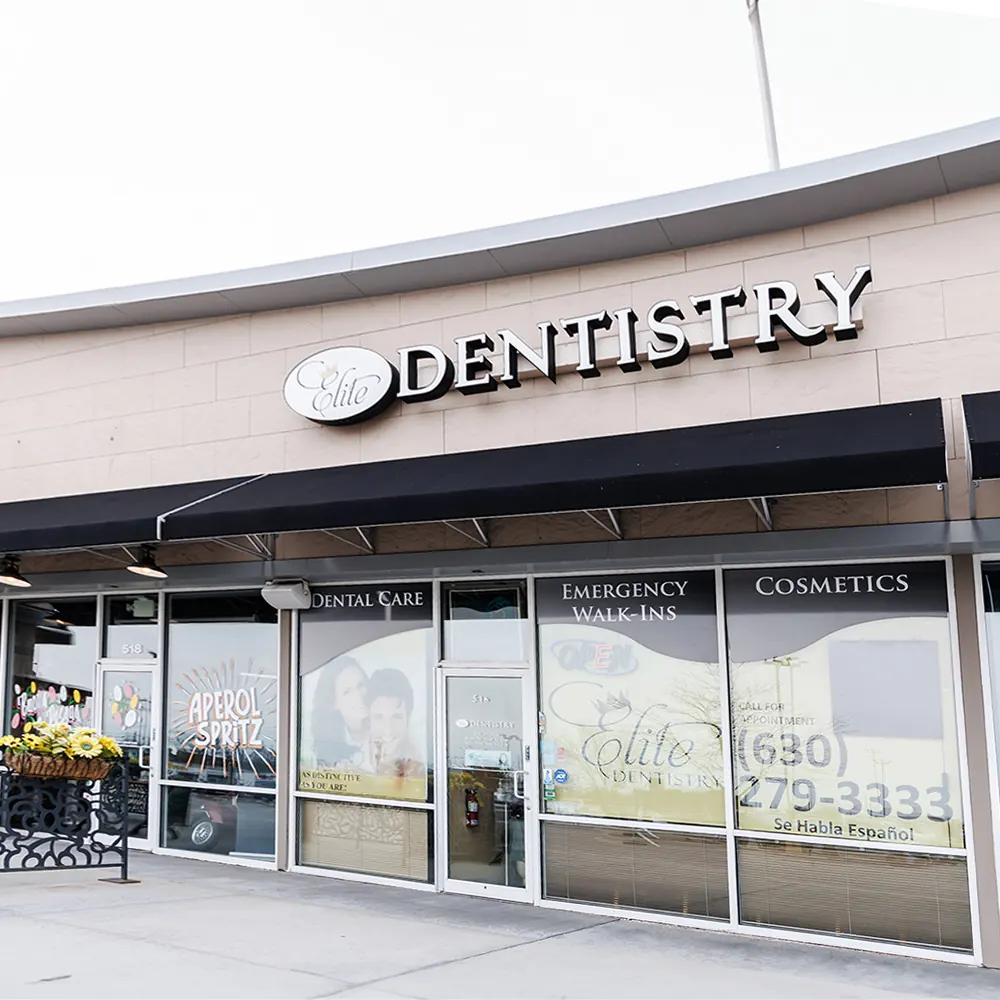
Located at 516 West Lake Street, our office is easy to reach for families throughout Addison, as well as nearby communities such as Villa Park, Elmhurst, Bensenville, Wood Dale, Lombard, Itasca, Glendale Heights, and Bloomingdale. For many parents juggling drop-off at Addison School District 4 elementary schools, after-school activities, and work commutes along Lake Street and Army Trail Road, convenience matters. That is why we offer Saturday hours from 8:00 a.m. to 2:00 p.m., so children do not always have to miss class for a checkup.
Our office was designed with comfort in mind. Children can relax in our play area while waiting, and parents can enjoy complimentary coffee or one of our massage chairs. Addison is a wonderfully diverse community, and our multilingual team speaks English, Spanish, Arabic, and Persian. Being able to communicate clearly with both children and parents in their preferred language helps families feel understood and confident in their care.
Many parents appreciate that we care for the entire household. Scheduling siblings and parents on the same day saves time, and seeing the same familiar faces year after year helps children feel secure. As your child’s kids’ dentist in Addison, we get to know their personality, their history, and what helps them feel comfortable, which makes every visit smoother.
Making Children’s Dental Care Affordable
Cost should never stand between a child and healthy teeth. We accept most PPO insurance plans and are happy to help you understand your family’s benefits before treatment. Many dental plans cover preventive care such as exams, cleanings, fluoride, and sealants at a high level, so routine visits are often very affordable.
For families without dental insurance, our Elite Membership program offers an accessible alternative. Membership for children is $79 per year and includes a 25% discount on most services. It is a simple way for parents to budget for their children’s dental care without the limitations that sometimes come with traditional insurance. Our front desk team is always glad to walk you through your options and answer questions about payment.
Your child’s smile is growing and changing every year, and the care it receives now lays the foundation for a lifetime of healthy teeth. At Elite Dentistry, we combine a gentle, patient approach with modern technology and a genuine love for working with children. Whether you are scheduling your baby’s very first visit, looking for a new dental home for your school-age kids, or helping a teenager through braces alternatives and sports seasons, our team is here to support your family every step of the way. If you have been looking for a kids’ dentist in Addison who treats your child like family, we would love to meet you. Call our office to schedule your child’s appointment, and let us help your little one build a smile they will be proud of for years to come.


A pedodontist is a dentist who has received advanced specialty training in meeting the dental needs of children from infancy to adolescence. Pedodontists, also referred to as "pediatric dentists," study child psychology, behavior management, caring for children with special needs, methods of handling oral/facial trauma, and various techniques for providing anesthesia and sedation. Pedodontists also understand the complexities of facial growth and development and have the clinical skills required to meet the dental needs of all children at every stage of development. Most of all, pedodontists are passionate about what they do and enjoy working with children. They strive to make every dental experience a positive one as they help children establish a strong foundation for good oral health.
Even before your child is born, their first set of teeth is already forming. In fact, by one year of age, some of your baby's front teeth will have already come into place. While the arrival of your baby's first teeth is only one of many developmental milestones, it represents an excellent time to begin a program of oral care. According to recommendations from the American Dental Association, babies should see the dentist around the time of their first birthdays.
Your baby's first teeth typically begin to appear in the 6 to 12-month range. While this is an extraordinary milestone, you need to be aware that your baby may find the experience a little bit uncomfortable. Teething can make babies feel irritable. They may be fussy, have trouble sleeping, not want to eat, and drool quite a bit.
Although you are powerless to speed up the process of teething, there are a few things that you can do to soothe your baby as the new teeth are erupting into place. Common approaches to helping your baby feel more comfortable while getting new teeth, include teething rings or a cold spoon or moist gauze rubbed over their gums.
Even for these few new teeth, it's absolutely essential to establish an effective regimen of oral care. For information on when your baby's first set of teeth will erupt into place, consult this timeline from the American Dental Association: Eruption Charts
Some children persist in sucking their thumbs or fingers beyond their preschool years. For these children, the activity continues to be a source of comfort, relaxation, and security. It may even help them fall asleep at night. However, it's essential to be aware that in the long-term, a finger sucking habit is not healthy.
If your child's thumb or finger sucking habit is still present when the permanent teeth begin to come in, your child is at a higher risk of developing a bad bite. By the age of five or six years, you need to constructively and gently help your child stop the habit.
It's also a good idea to have a comprehensive evaluation at this time. Your pedodontist can assess if there are any habit related alterations to the alignment of your child's teeth or jaws, or if it is affecting their speech or swallowing patterns. They can also discuss habit control strategies with you, as well as follow your child's bite and facial development as they grow. If interceptive appliances or corrective orthodontic care are recommended, the timetable and best options in care will be explained in complete detail.
Ready to schedule your next dental appointment or have questions about our services?
Contacting Elite Dentistry is easy! Our friendly staff is available to assist you with scheduling appointments, answering inquiries about treatment options, and addressing any concerns you may have. Whether you prefer to give us a call or fill out our convenient online contact form, we're here to help. Don't wait to take the first step towards achieving the smile of your dreams – reach out to us today and discover the difference personalized dental care can make.
